


 Home
Home



High concentration, small particle size micro nano bubble generation device developed in the laboratory
Click:2149Date:2026-04-21 01:11:23
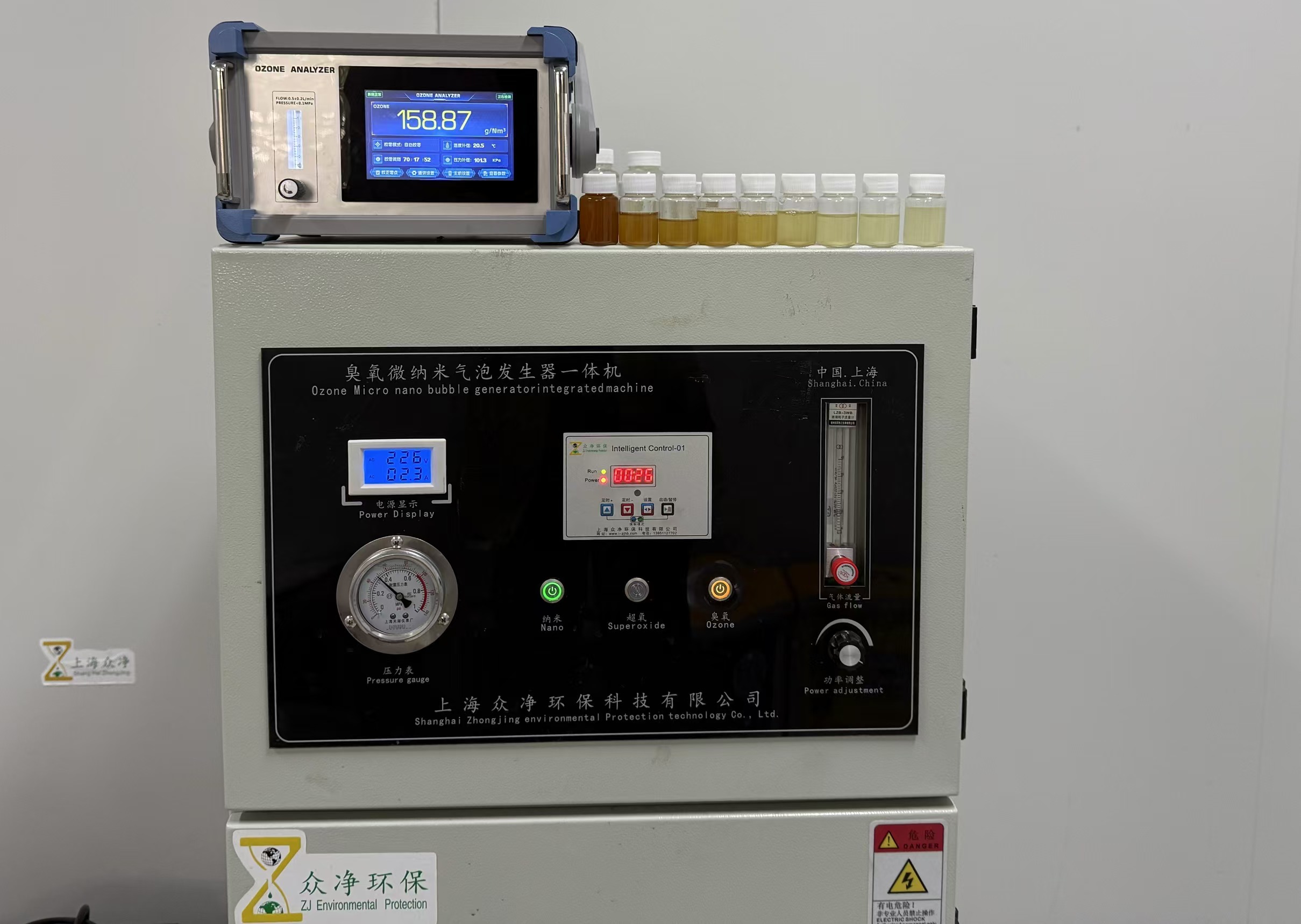
The ZJC-NM series device developed by Shanghai Zhongjing Environmental Technology Co., Ltd. is a high-concentration, small-particle-size micro-nano bubble generation equipment designed for laboratory needs. Its core technology employs a coupled mechanism of multiphase fluid vortex cutting and hydraulic cavitation, capable of stably generating nanobubbles with particle sizes ranging from 10 to 100 nanometers.
1. Core Technologies and Principles
Technical Principle: The gas-liquid two-phase medium forms high-speed turbulent flow within the pressurization chamber, which is then progressively fragmented through a multi-stage precision rotary cutting structure, ultimately creating a coexisting system of nanoscale and microscale bubbles.
Bubble characteristics:
Particle size distribution: 10–100 nanometers (small particle size range)
• Bubble concentration: The gas content can reach 85%–90% (high concentration)
Oxygen transfer efficiency: Over 85% (Traditional aeration methods are only 20%–35%)
Residence time: 20 to 30 minutes in water (approximately 1/100 of traditional bubble residence time)
Special effects: The collapse of a bubble can generate temperatures of approximately 4,400°C and a high pressure of 10 atmospheres, stimulating highly oxidative hydroxyl radicals (・OH).
II. Core Parameters of Experimental Model (ZJC-NM Series)```
Flow regulation range:
Liquid flow rate: 0.3–2 liters per minute
Gas flow rate: 2–300 mL/hour
Material Construction: The flow-passing components are made of SUS316L stainless steel or polytetrafluoroethylene (PTFE), which are resistant to corrosive media such as ozone and hydrogen peroxide.
Temperature control: Designed with no significant thermal rise to avoid noticeable changes in the temperature of experimental liquids, suitable for precision experiments in biology, chemistry, and other fields.
Control System: Equipped with a central processor for intelligent control, it enables real-time monitoring and adjustment of flow rate, pressure, bubble particle size, and operating time.
Applicable gas sources: Supports various gases such as air, oxygen, ozone, nitrogen, carbon dioxide, and hydrogen.
III. Key Features
Precise and controllable: All operational parameters are digitally adjustable, ensuring high stability and experimental reproducibility in bubble size, concentration, and gas-liquid ratio.
Stable operation: Supports continuous long-term operation with low failure rates, suitable for extended scientific research experiments.
Scene Adaptation: Designed specifically for universities, research institutes, and corporate R&D centers, this compact structure is suitable for small-batch water sample testing.
IV. Typical Application Areas
Water treatment research: advanced oxidation processes, pollutant degradation, and simulation of black and odorous water body remediation.
Environmental Science: Soil Remediation, Heavy Metal Ion Adsorption, and Solid-Liquid Separation Experiments.
Biomedical: Cell culture, oxygen-enriched water preparation, sterilization and disinfection, bioactive research.
Materials Science: Nanomaterial Preparation, Surface Modification, Catalytic Reaction Experiments.
Food and Agriculture: Research related to fruit and vegetable washing, aquaculture oxygenation, food safety testing, and more.